No Products in the Cart


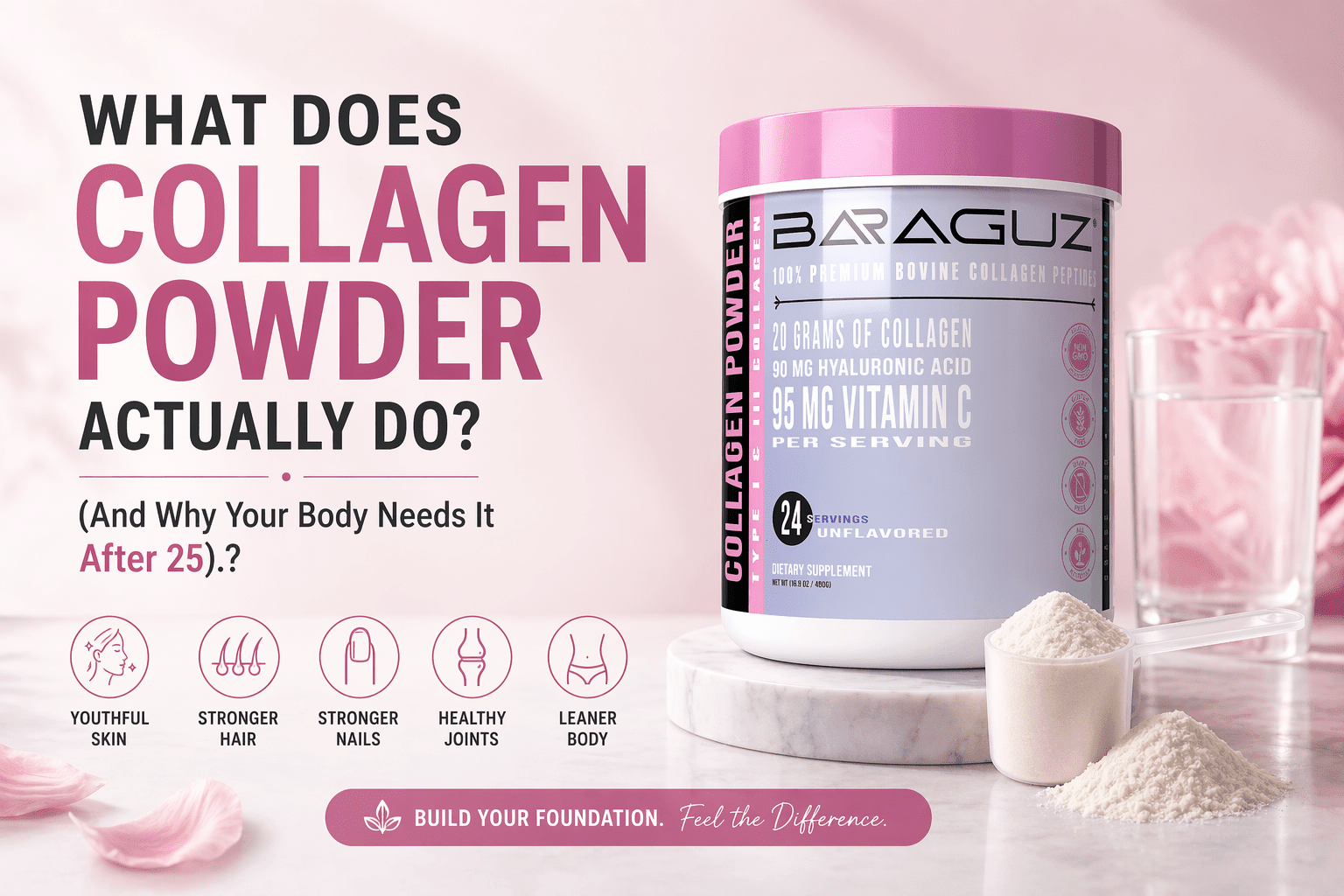
You've probably noticed collagen powder everywhere lately — in coffee shops, on wellness influencer feeds, in your friends' smoothies. But is it actually doing anything, or is it just an expensive habit?
Here's the short answer: your body is losing collagen right now. And it started earlier than you think.
Collagen is the most abundant protein in the human body. It's the structural foundation that keeps your skin firm, your joints cushioned, your hair strong, and your gut lining intact. Think of it as the scaffolding that holds everything together from the inside out.
The problem? Your body's natural collagen production starts declining as early as your mid-20s — dropping by roughly 1% every year after that. By your 30s and 40s, the effects become visible: fine lines appear, skin loses its bounce, joints start to feel stiffer, and hair seems thinner than it used to be.
Diet alone can't fully replace what's being lost. That's where collagen supplementation comes in.
Not all collagen supplements are created equal. The type of collagen you take determines exactly what it supports in your body.
Type I collagen is the most abundant collagen in the human body. It's responsible for skin elasticity, strength, and hydration — and it's the primary collagen found in bones, tendons, and ligaments.
Type III collagen works alongside Type I. It forms the flexible connective tissue found in muscles, organs, blood vessels, and the walls of your gut. It's critical for tissue resilience and plays a role in early-stage tissue repair.
Bovine collagen peptides — sourced from grass-fed cattle hides — naturally deliver both Type I and Type III collagen in a single supplement. This dual-action profile makes bovine collagen one of the most comprehensive options available, supporting your skin, joints, gut, and connective tissue all at once.
When the collagen is hydrolyzed (broken down into smaller peptide chains), it becomes highly bioavailable — meaning your body can absorb and use it efficiently, without it just passing through.
Collagen is what gives young skin its plumpness and elasticity. As levels drop, skin thins and wrinkles form. Multiple clinical studies have found that daily supplementation with hydrolyzed collagen peptides improves skin hydration, increases elasticity, and reduces the visible depth of fine lines — typically within 8 to 12 weeks of consistent use.
Collagen provides the amino acid foundation your body uses to produce keratin — the structural protein in hair and nails. Many users report noticeably thicker hair and less breakage, along with faster-growing, harder nails, after 60 to 90 days of daily use.
Type I and III collagen support the cartilage, tendons, and ligaments that keep your joints moving smoothly. If you experience morning stiffness, discomfort after exercise, or general joint soreness, collagen supplementation can help rebuild the connective tissue that cushions and supports those structures over time.
Type III collagen plays a direct role in maintaining the integrity of the gut lining. A strong gut lining supports better digestion, nutrient absorption, and a healthy immune response. This is why collagen is widely recommended by functional medicine practitioners for gut health protocols.
Collagen is a complete source of several key amino acids — particularly glycine, proline, and hydroxyproline — that support muscle repair after exercise. While collagen isn't a replacement for whey protein, it complements a fitness routine by helping repair connective tissue that takes the brunt of physical training.
Taking collagen alone is effective. Taking collagen alongside the right cofactors is even better.
Hyaluronic Acid is a naturally occurring molecule that holds up to 1,000 times its weight in water. It works synergistically with collagen to keep skin deeply hydrated, plump, and resilient. As we age, hyaluronic acid levels decline alongside collagen — which is why combining both in a single supplement makes practical sense.
Vitamin C is non-negotiable for collagen synthesis. Your body cannot produce collagen without it. Vitamin C acts as an essential cofactor in the enzymatic process that converts amino acids into usable collagen fibers. Without adequate Vitamin C, even the best collagen supplement will underperform.
This is exactly why Baraguz Premium Bovine Collagen Peptides combines Type I & III collagen with both Hyaluronic Acid and Vitamin C — so your body has everything it needs to absorb, utilize, and rebuild collagen as efficiently as possible.
One scoop of Baraguz Collagen Powder, once daily. Mix it into any hot or cold liquid — coffee, tea, a smoothie, or just water. It dissolves cleanly with no clumping and no aftertaste.
A few tips to get the most out of it:
The honest answer? Most adults over 25 can benefit from it. But it's especially relevant if you:
Collagen powder isn't a trend — it's one of the most well-researched supplements available, with a clear mechanism of action and a growing body of clinical evidence behind it. The key is choosing a formula that pairs high-quality hydrolyzed peptides with the cofactors that make them work.
Baraguz Premium Bovine Collagen Peptides delivers Type I and III collagen alongside Hyaluronic Acid and Vitamin C — everything your body needs to rebuild from the inside out, one scoop at a time.
Shop Baraguz Collagen Powder →
These statements have not been evaluated by the Food and Drug Administration. This product is not intended to diagnose, treat, cure, or prevent any disease. Consult your healthcare provider before starting any new supplement.
